
Virginia Marriage Records
Virginia marriage records are held by circuit court clerks in each county and independent city where the license was issued. The Virginia Department of Health Office of Vital Records in Richmond also keeps certified copies of marriage certificates for events from 1936 to the present. You can search for and request records online, by mail, or in person. Older records going back to the 1700s are at the Library of Virginia. Whether you need a certified copy for a legal matter or you are tracing family history, this page covers every way to find and access Virginia marriage records.
Virginia Marriage Records at a Glance
Where Virginia Marriage Records Are Kept
Marriage records in Virginia are kept at two main levels. The circuit court clerk in each county or independent city holds the original marriage license and certificate for every marriage that took place in that jurisdiction. When an officiant performs a ceremony, they must file the completed certificate back with the clerk within five days under Virginia Code § 32.1-267. The clerk then forwards a monthly report to the state. That means both local and state records reflect the same event, though the local clerk's office is usually the best starting point when you know the county or city where the marriage occurred.
The Virginia Department of Health Office of Vital Records in Richmond is the central state source for certified marriage certificates. Their walk-in office is located at 8701 Park Central Drive, Suite 100, Richmond, VA 23227, and is open Monday through Friday from 7:00 AM to 4:00 PM. You can reach them by phone at 804-662-6200 or by mail at P.O. Box 1000, Richmond, Virginia 23218-1000. Their online portal lets you apply for a certified copy, pay electronically, and track your order without visiting in person. The state's records cover marriages from 1936 to the present. For records predating 1936, the Library of Virginia holds historical collections going back to the colonial period. The two systems together give researchers access to more than 300 years of Virginia marriage history.
The state's online request system has made the process significantly faster and more accessible for most people, with no need to travel to Richmond for routine requests.
The Virginia Department of Health Vital Records office processes certified marriage certificate requests and maintains the central repository for all marriages recorded since 1936 across the Commonwealth.
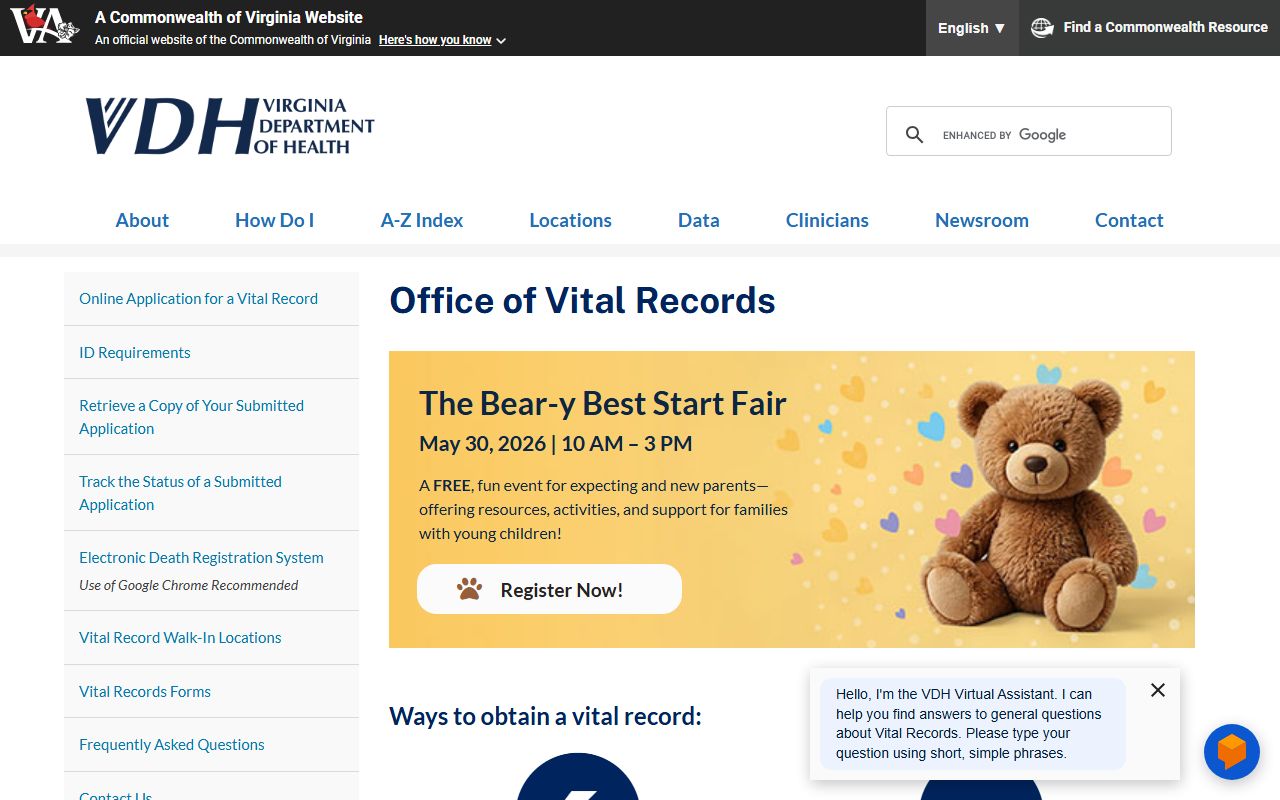
Requests submitted online, by mail, or as a drop-off at the Richmond office are all handled here, with payment accepted by check, money order, credit card, mobile pay, or cash.
How to Request Virginia Marriage Records
Three main methods are available for requesting a Virginia marriage record: online through the state portal, by mail, or in person. The online system through the Virginia Department of Health is the fastest route for most people. You fill out the form, pay the fee, and receive status updates by email. The office mails the certified copy when it is ready, or you can arrange to pick it up at the Richmond location.
Mail requests go to VDH Office of Vital Records, P.O. Box 1000, Richmond, Virginia 23218-1000. Include a completed application, a legible copy of your photo ID, and payment. Checks and money orders should be made payable to "State Health Department." The drop-off option at the Richmond walk-in office is also available. For drop-offs, bring the application signed by the requester, a copy of your ID, and payment. Cash, check, money order, credit card, and mobile pay are all accepted. Applications received after 2:00 PM count as received the next business day. Note that the drop-off option is not available for amendments or corrections to existing records.
Going directly to the circuit court clerk in the county or city where the marriage occurred is another solid approach, especially for older records that may not yet be in the state system. Clerks keep the original license and certificate and can make certified copies. Call ahead to confirm the office's hours, fees, and what ID or documentation they require.
The statute at Virginia Code § 20-16 established the sworn application process that both marriage license applicants must follow, and it is this same process that creates the original record that later becomes available for certified copy requests.
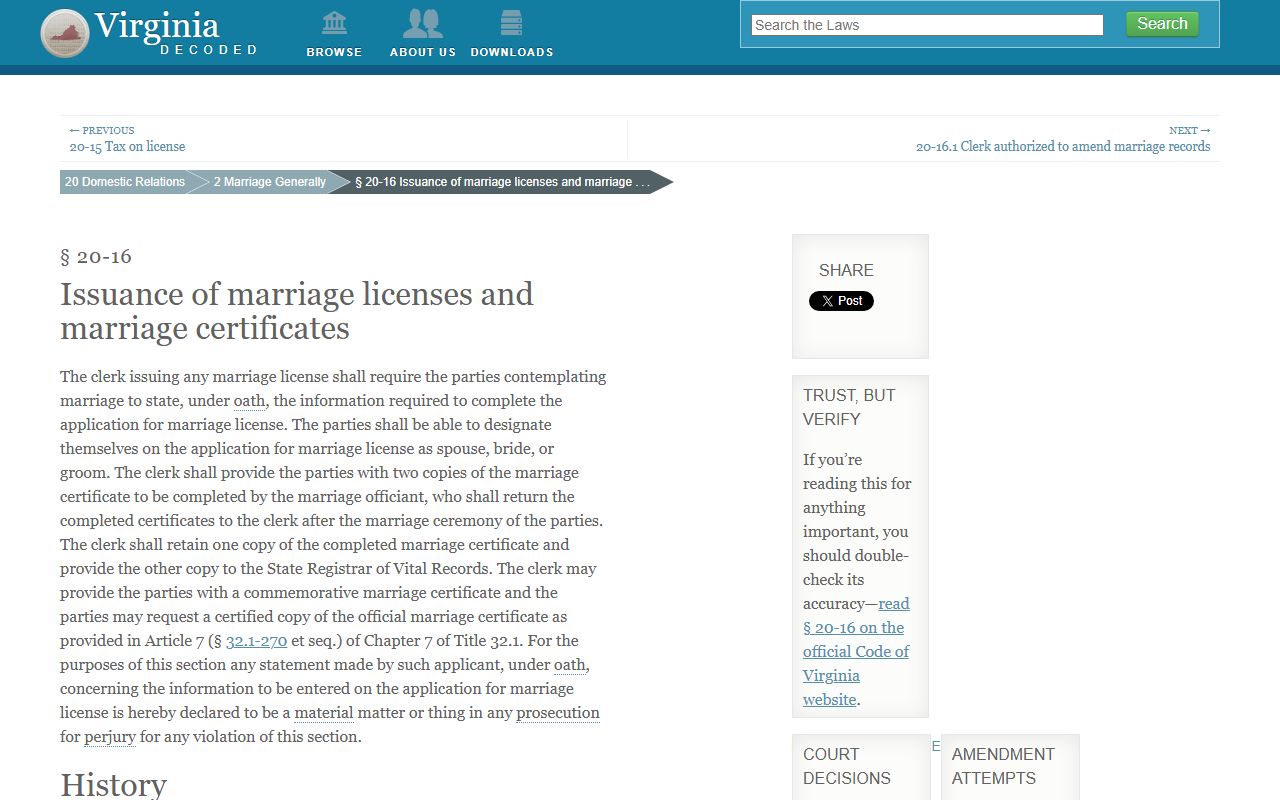
The statute also requires that applicants sign the application under oath, with false statements subject to perjury prosecution, which helps ensure the accuracy of Virginia's marriage record system.
Virginia Marriage License Requirements
Under Virginia Code § 20-13, every marriage in the Commonwealth must be performed under a valid license and solemnized in the manner provided by law. Licenses are issued by the clerk or deputy clerk of any circuit court in Virginia, as established by § 20-14. You do not have to apply in the county where you live or plan to hold the ceremony. Any circuit court across the state can issue the license, and it is valid everywhere in Virginia for 60 days from the date of issue. There is no waiting period between getting the license and the ceremony.
Both people must appear together in person to apply. The clerk will ask each applicant to provide information under oath as required by § 20-16. Each person must be at least 18 years old. Parties under 18 are not eligible to apply without a court order of emancipation. The application lets you designate yourself as "spouse," "bride," or "groom," giving flexibility for how each person is identified on the record. License fees vary by jurisdiction. Alexandria, for example, charges $30 and accepts cash, check, money order, and credit card. Your local circuit court will have the current fee for their office.
- Valid government-issued photo ID for both applicants
- Social security number for both parties (blocked from public view on post-1997 applications)
- The license fee (often $30, varies by jurisdiction)
- Documentation of any prior marriage ending in divorce or death if applicable
- Court order of emancipation if either party is under 18
Note: Virginia marriage licenses are valid for 60 days and can be used anywhere in the state, but they cannot be used outside of Virginia and expire if the ceremony does not take place within that window.
Who Can Access Virginia Marriage Records
Virginia limits access to certified copies of marriage records to close family members of the record subject. Only the person named on the record, their spouse, parents, children, siblings, and grandparents can request a certified copy from VDH. Each person must provide valid identification that meets the requirements under the State Registrar's ID rules. Primary ID documents include a state-issued driver's license or photo ID card, a U.S. passport, a U.S. military ID for active duty or retired members, or certain unexpired immigration documents including resident alien cards and employment authorization documents. If you do not have primary ID, two acceptable secondary documents may be used together in place of one primary form.
Marriage records become fully public information 25 years after the date of the event. This timeline is set in Virginia Code § 32.1-271. Once that 25-year period passes and records are in the State Registrar's custody, they are transferred to the Library of Virginia for open public access. At that point, anyone can view or copy them with no proof of relationship required. This is why the Library of Virginia holds an extensive collection of older marriage records that predate the VDH system. The State Registrar also maintains a publicly available online vital records index that includes name, date, and county or city of occurrence for all marriages, making it easier to locate records before requesting a certified copy.
Virginia's Freedom of Information Act governs access to certain government records including some marriage-related documents. Under § 2.2-3704, public bodies must respond to records requests within five working days. Social security numbers on marriage license applications filed after July 1, 1997 are blocked from public view by law. If you have questions about what records you are entitled to see, the Virginia FOIA Advisory Council can help. They can be reached at 804-698-1810 or toll-free at 1-866-448-4100.
The Code of Virginia sets out all the rules for who may access vital records, what identification is required, and when records transition from restricted to public status.
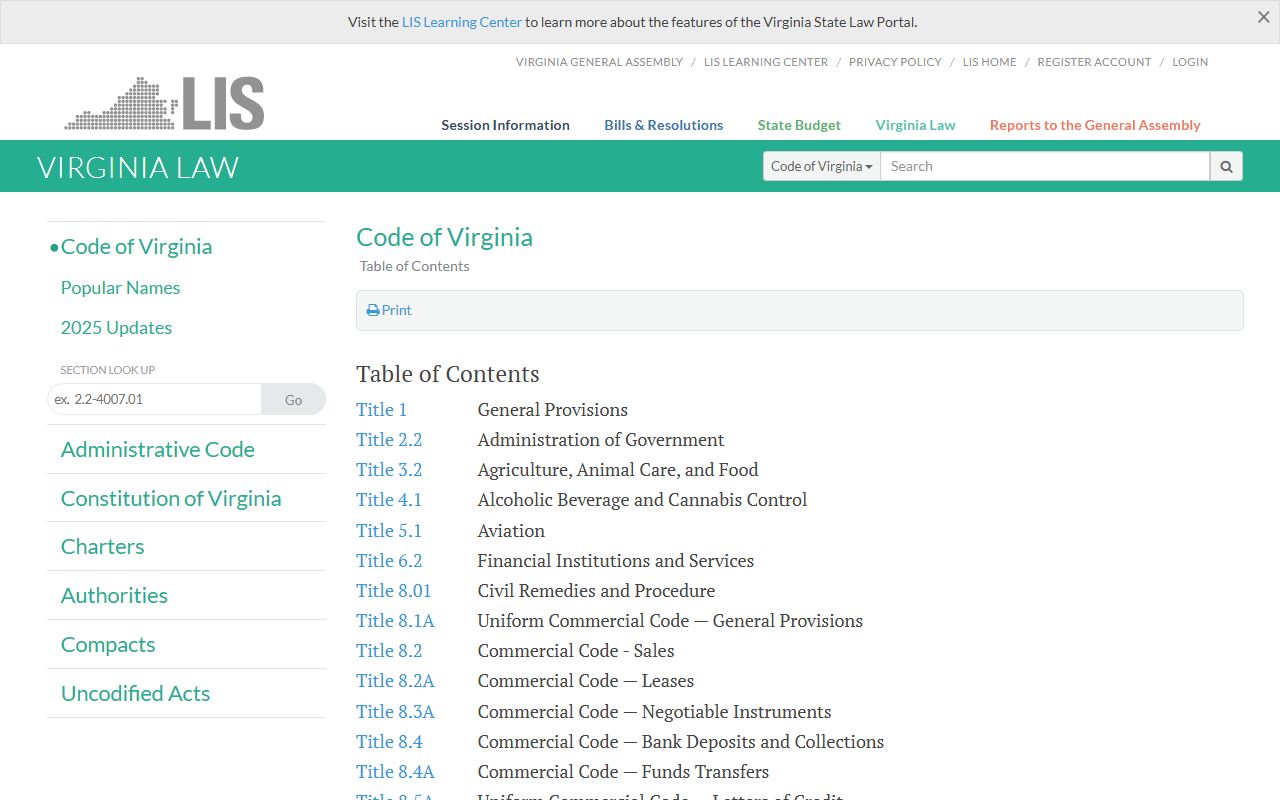
Titles 20 and 32.1 of the Code cover marriage licensing and vital records respectively, establishing the complete legal framework for record requests in the Commonwealth.
Historical Marriage Records in Virginia
For anyone researching older marriages, the Library of Virginia at 800 East Broad Street in Richmond is the right place to start. The Library serves as the Commonwealth's official archive and holds over 130 million items related to Virginia's history and government. Historical marriage records spanning from 1719 through 1898 are part of this collection. Many are searchable through the Library's online digital platforms, and staff at the reference desk can help researchers plan their search approach. The Library also maintains cohabitation registers for married former enslaved people, making it one of the most important resources for African American genealogical research in the South. You can reach the Library by phone at (804) 692-3500.
For counties that suffered courthouse fires or other disasters that destroyed original records, the Library's collections may hold the only surviving marriage documentation. Beyond the Library, FamilySearch maintains a large free database with Virginia marriage records indexed from county-level sources. The Virginia Courts website provides contact information for every circuit court in the state, which can help you identify and reach the right clerk's office directly. Some county clerks also keep older records on microfilm or in indexed ledgers that are not part of any digital system, so calling the local office is always worth the effort for hard-to-find historical marriages.
The Virginia Code § 32.1-273 establishes the fee structure for certified copies of vital records, including marriage certificates, and authorizes DMV offices statewide to issue certified copies in addition to VDH.
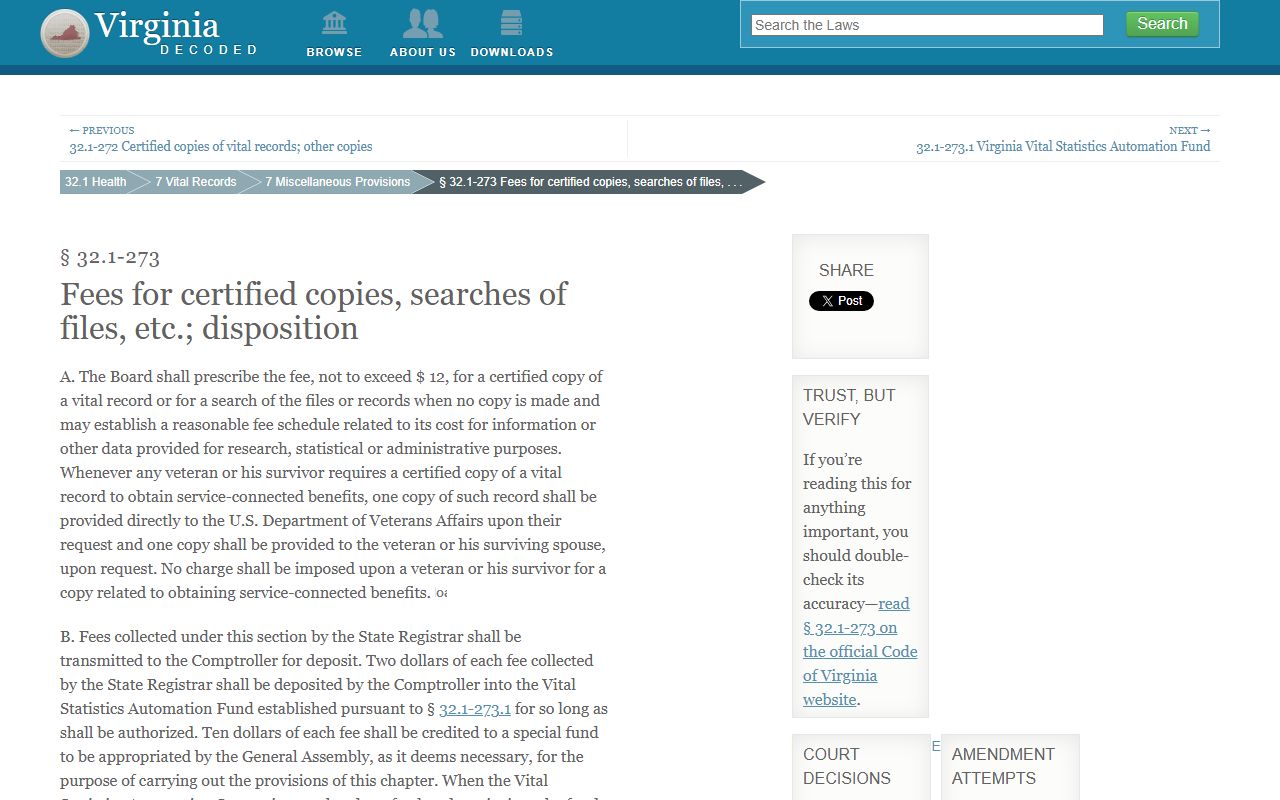
Under this statute, veterans and their survivors can obtain one free certified copy when needed to claim service-connected benefits, with a copy also sent directly to the U.S. Department of Veterans Affairs on request.
Certified Copies of Virginia Marriage Certificates
The maximum fee for a certified copy of a Virginia marriage certificate is $12, set by the Board of Health under § 32.1-273. This fee applies whether you get the copy from VDH by mail, in person, or online. It also covers the cost of searching the files even if no copy is ultimately made. Of the $12 collected, $2 goes to the Vital Statistics Automation Fund to support system modernization and $10 supports health department operations. DMV offices across Virginia can also issue certified copies under the same statute, though the DMV charges an additional $2 processing fee making the total $14 at that route.
A certified copy issued by VDH, DMV, or a circuit court clerk carries legal weight under § 32.1-272. It is treated as the same as the original document and serves as prima facie evidence of the facts stated in it. That legal standing makes certified copies valid for name changes after marriage, updating insurance policies, settling estate matters, and a wide range of other official uses. Records marked "delayed" or "amended" will be labeled as such on any copy issued. The evidentiary weight of an amended or delayed record may be reviewed by a court or administrative body on a case-by-case basis.
Note: Circuit court clerks set their own fees for locally held records, which may differ from the state VDH fee, so confirm costs directly with the specific clerk's office before your visit.
How Virginia Marriage Records Are Filed and Indexed
After every marriage ceremony, the filing process follows a specific legal timeline. The officiant who performs the ceremony must certify the facts of the marriage and return the completed certificate to the clerk who issued the license within five days. The clerk then files and preserves the original in their office and creates an index of both parties' names as required by Virginia Code § 20-20. This indexed filing is what makes it possible to search for a marriage record by either spouse's name. On or before the tenth day of each month, the clerk forwards records of all marriages from the prior month to the State Registrar at VDH.
Officiants who fail to return the completed certificate create what are called unreturned licenses. Under § 20-21, clerks are required to report all such licenses to the Commonwealth's Attorney each year by March 31. This oversight mechanism helps keep the record system complete and accurate. Any certified copy made from a properly filed and indexed marriage record carries prima facie evidentiary value in all Virginia courts, meaning it is presumed accurate and authentic unless contradicted by other evidence.
The § 20-20 clerk filing process is what links local court records to the statewide vital records system maintained by VDH.
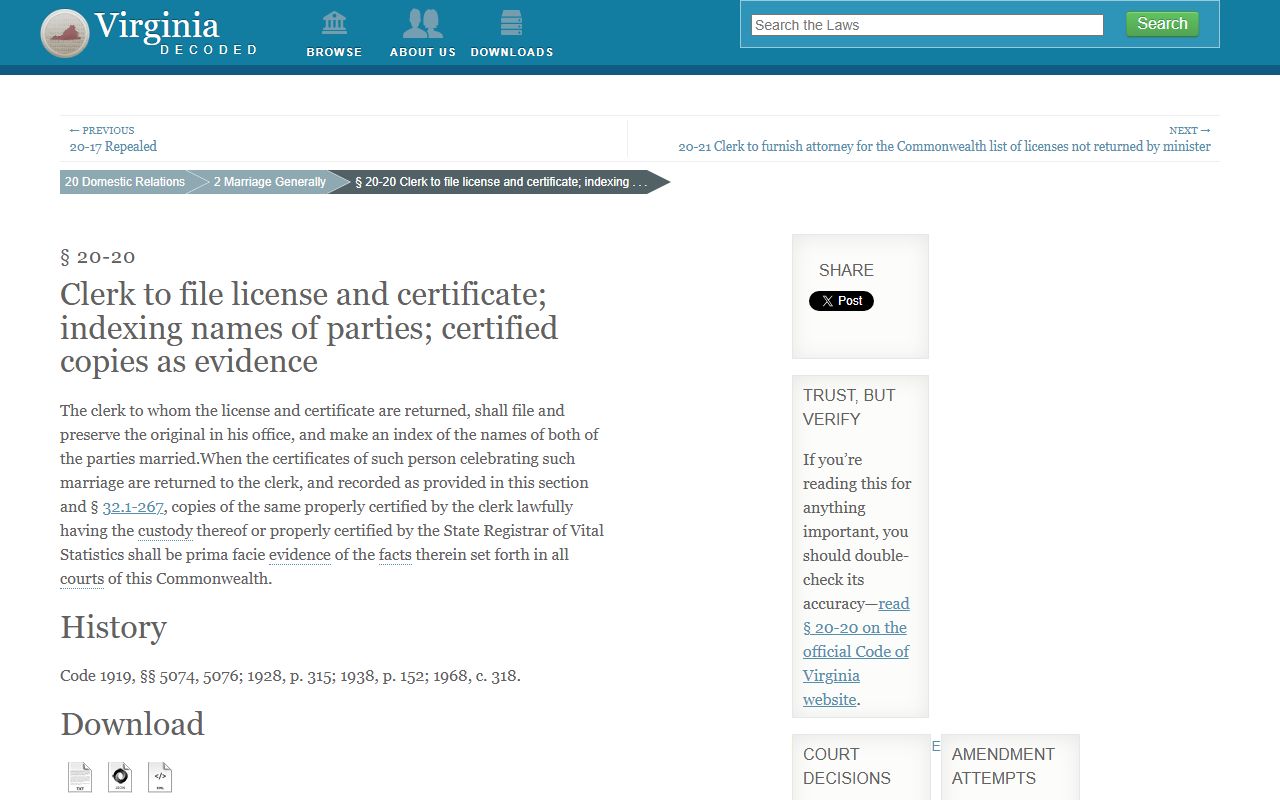
The dual filing requirement, with both local clerk retention and monthly state reports, creates redundancy in the system and helps preserve marriage records even when one repository has gaps or issues.
Browse Virginia Marriage Records by Location
Marriage records in Virginia are managed at the local level. Each circuit court clerk handles records for their specific county or independent city. Select a location below to find contact details, office hours, and resources for marriage records in that area.
Virginia Counties
Virginia has 95 counties, each with its own circuit court clerk who issues marriage licenses and maintains local marriage records. Select a county to find specific office information and resources.
Virginia Marriage Records by City
Virginia's 39 independent cities each operate their own circuit courts separate from county government. Each city clerk issues marriage licenses and keeps local records. Select a city to find marriage record resources for that area.